AmesWeb

Simply Supported Beam Calculator — Point, Moment, Uniform & Varying Loads

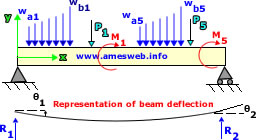
Compute support reactions, shear V(x), bending moment M(x), slope θ(x), deflection y(x), and bending stress σ for a simply supported beam with any combination of point loads, concentrated moments, UDLs, and linearly varying (trapezoidal) loads. Superposition with Macaulay brackets.

Sign convention used

  • Coordinate x: measured from the left support toward the right.
  • Loads: downward point loads and distributed loads are entered as positive.
  • Shear force V(x): positive when it acts upward on the left face of the cut section (equivalently, when it tends to rotate the segment clockwise).
  • Bending moment M(x): positive (sagging) when the beam is concave up and the top fibers are in compression. Negative (hogging) moments put the bottom fibers in compression.
  • Concentrated moments: a positive M produces sagging, a negative M produces hogging.
  • Slope θ(x): positive when the deflected centerline rotates counter-clockwise (upward to the right).
  • Deflection y(x): reported with sign from the differential equations of the elastic curve. For typical positive downward loading, sagging deflections at mid-span will appear with a negative sign; the calculator also reports |y|max as an algebraic extremum.

Use the sign of V(x), M(x), θ(x), and y(x) together with the charts to interpret the beam response.

Global units

Input parameters

Point loads (P at a)

Simply supported beam: point load P at distance a from the left (origin at left)
Point load P at distance a from the left support (origin at left).
P (lbf) a (from left) (ft) Action
Unit: lbf Unit: ft
+ Add load

Concentrated moments (M at a)

Simply supported beam: concentrated moment M0 at distance a from the left (origin at left)
Concentrated moment M₀ at distance a from the left support (origin at left).
M (lbf·in) a (from left) (ft) Action
Unit: lbf·in Unit: ft
+ Add moment

Positive M produces sagging (top fibers in compression). Reactions from a positive M are R₁ = +M/L and R₂ = −M/L.

UDL segments (intensity w from s to e)

Simply supported beam: UDL w from s to e measured from the left (origin at left)
UDL intensity w from s to e (measured from the left/origin).
w (lbf/ft) s (start) (ft) e (end) (ft) Action
Unit: lbf/ft Unit: ft Unit: ft
+ Add UDL

For a uniform load over [s, e], total load W = w·(e−s) acting at x̄ = (s+e)/2.

VDL segments (linearly varying load w₁→w₂ from s to e)

Simply supported beam: VDL w1 to w2 from s to e measured from the left (origin at left)
VDL varying from w₁ at s to w₂ at e (measured from the left/origin).
w₁ (at s) (lbf/ft) w₂ (at e) (lbf/ft) s (start) (ft) e (end) (ft) Action
Unit: lbf/ft Unit: lbf/ft Unit: ft Unit: ft
+ Add VDL

Trapezoidal load: total W = (w₁+w₂)/2 · (e−s). Centroid \(x̄ = s + (e-s)\frac{w_1+2w_2}{3(w_1+w_2)}\).

Unit: ft
Unit: ft
Unit: ksi
Unit for c:
Unit: in⁴
  • Use dot “.” as decimal separator.
  • Constraints: 0 ≤ aᵢ ≤ L; 0 ≤ sⱼ < eⱼ ≤ L; 0 ≤ x ≤ L.
  • Sign convention: downward loads positive; positive moments cause sagging.

Results

ParameterValue
Reaction Force R₁--- lbf
Reaction Force R₂--- lbf
Shear @ x (Vₓ)--- lbf
Max Shear (Vmax)--- lbf
Moment @ x (Mₓ)--- lbf·in
Max Moment (Mmax)--- lbf·in
Slope @ x (θₓ)--- radian
Max Slope (θmax)--- radian
End Slope Left (θ₁)--- radian
End Slope Right (θ₂)--- radian
Deflection @ x (yₓ)--- inch
Max Deflection (|y|max)--- inch
Bending Stress @ x (σₓ)--- psi
Max Bending Stress (σmax)--- psi

Inputs used in calculation

Charts

FAQ

Which way is positive?

Downward loads \(+\). Positive moments sag the beam (top fibers in compression). Concentrated moments follow sagging-positive.

How are UDL and VDL handled?

Each UDL \(w\) on \([s,e]\) contributes \(W=w(e-s)\) at \(\bar{x}=(s+e)/2\). A linearly varying load \(w_1\to w_2\) on \([s,e]\) has \(W=\frac{w_1+w_2}{2}(e-s)\) at \(\bar{x}=s+(e-s)\frac{w_1+2w_2}{3(w_1+w_2)}\).

What assumptions are made?

Euler–Bernoulli, small deflections, constant \(E\) and \(I\) along the span, prismatic beam, linear elastic material, simple supports without settlement.

Worked example (multiple point loads + UDL)

This example shows how to reproduce a full beam analysis using the calculator above: reactions, shear, bending moment, slope, deflection, and bending stress.

Show the worked example

Problem

A timber beam AB of span 3 m, width 200 mm and height 100 mm supports three concentrated loads as shown. The elastic modulus is 8 GPa and the density is 600 kg/m³.

  • Goal Find max deflection, max shear, max bending moment, mid-span deflection/slope, and end reactions.
  • Sign convention Downward loads positive; sagging moments positive.
Timber beam with three point loads over a 3 m span

Step 1 — Inputs

ParameterValueUnit
Timber width, b100mm
Timber height, H200mm
Span, L3000mm
Mid-span position, x1500mm
Elastic modulus, E8GPa
Beam typeSimply supported with multiple point loads + UDL

Step 2 — Section properties (rectangle)

Compute the rectangular section properties using: Solid Rectangle — Sectional Properties Calculator.

Rectangular section properties
ParameterValueUnit
Second moment, Ixx66,666,668mm⁴
Section modulus, Sxx666,666.688mm³

For bending stress at the extreme fiber, use \(c=H/2=50\;\mathrm{mm}\).

Step 3 — Enter the case into this calculator

Beam self-weight UDL: \(w = (M g)/L = 36 \cdot 9.81 / 3 = 117.7\;\mathrm{N/m}\).

Point loads

#Location (m)Magnitude (kN)
10.510
21.55
32.510

Distributed loads

#Start (m)w (N/m)End (m)w (N/m)
10117.73117.7

Beam & material

ParameterSymbolValueUnit
Beam lengthL3m
Report positionx1.5m
Elastic modulusE8GPa
Extreme fiber distancec50mm
Second momentI66,666,668mm⁴

Tip: set your global units to m, kN, kN·m (or use N/m and convert consistently).

Step 4 — Results (reference)

Simply supported beam deflection diagram showing point loads, UDL, reactions and slopes
ParameterValueUnit
Reaction Force R₁12676.5N
Reaction Force R₂12676.5N
Shear @ x2500.0N
Max Shear12676.5N
Moment @ x8882.4N·m
Max Moment8882.4N·m
Slope at left, θ₁-0.988degree
Slope at right, θ₂0.988degree
Deflection @ x-15.662mm
Max Deflection-15.662mm
Bending Stress @ x6.7MPa

Formula library for common load cases

These closed-form equations match the calculator’s solver (Macaulay/singularity functions) and are useful for hand checks.

Macaulay bracket: \(\langle x-a\rangle^n = 0\) for \(x < a\) and \(\langle x-a\rangle^n = (x-a)^n\) for \(x \ge a\).

A) Point load P at position a
Simply supported beam with point load P at distance a from the left support
Point load at distance a from the left support on span L.
$$R_1=\frac{P(L-a)}{L},\qquad R_2=\frac{Pa}{L}$$ $$V(x)=R_1 - P\langle x-a\rangle^{0}$$ $$M(x)=R_1\,x - P\langle x-a\rangle^{1}$$ $$\theta(x)=\theta_1+\frac{R_1 x^{2}}{2EI}-\frac{P}{2EI}\,\langle x-a\rangle^{2}$$ $$y(x)=\theta_1\,x+\frac{R_1 x^{3}}{6EI}-\frac{P}{6EI}\,\langle x-a\rangle^{3}$$ $$\sigma(x)=\dfrac{M(x)\,c}{I}$$
B) Linearly varying (trapezoidal / triangular) load w₁→w₂ on [s,e]
Simply supported beam with linearly varying distributed load from w1 at s to w2 at e
Linearly varying distributed load from \(w_1\) at \(s\) to \(w_2\) at \(e\).
Let \(\ell=e-s\), \(k=\dfrac{w_2-w_1}{\ell}\), \(W=\dfrac{w_1+w_2}{2}\ell\).
$$\bar{x}=s+\ell\,\frac{w_1+2w_2}{3(w_1+w_2)}$$ $$R_2=\frac{W\bar{x}}{L},\qquad R_1=W-R_2$$ $$V(x)=R_1-\Big[w_1(\langle x-s\rangle-\langle x-e\rangle)+\frac{k}{2}\big(\langle x-s\rangle^2-\langle x-e\rangle^2\big)\Big]$$ $$M(x)=R_1x-\Big[\frac{w_1}{2}\big(\langle x-s\rangle^2-\langle x-e\rangle^2\big)+\frac{k}{6}\big(\langle x-s\rangle^3-\langle x-e\rangle^3\big)\Big]$$ $$\theta(x)=\theta_1+\frac{R_1x^2}{2EI}-\frac{1}{EI}\Big[\frac{w_1}{6}\big(\langle x-s\rangle^3-\langle x-e\rangle^3\big)+\frac{k}{12}\big(\langle x-s\rangle^4-\langle x-e\rangle^4\big)\Big]$$ $$y(x)=\theta_1x+\frac{R_1x^3}{6EI}-\frac{1}{EI}\Big[\frac{w_1}{24}\big(\langle x-s\rangle^4-\langle x-e\rangle^4\big)+\frac{k}{60}\big(\langle x-s\rangle^5-\langle x-e\rangle^5\big)\Big]$$ $$\sigma(x)=\dfrac{M(x)c}{I}$$
C) Concentrated moment M₀ at position a
Simply supported beam with applied point moment M₀ at distance a
Applied couple moment \(M_0\) at distance \(a\).
$$R_1=-\frac{M_0}{L},\qquad R_2=\frac{M_0}{L}$$ $$V(x)=R_1$$ $$M(x)=R_1x+M_0\langle x-a\rangle^{0}$$ $$\theta(x)=\theta_1+\frac{R_1x^2}{2EI}+\frac{M_0}{EI}\langle x-a\rangle^{1}$$ $$y(x)=\theta_1x+\frac{R_1x^3}{6EI}+\frac{M_0}{2EI}\langle x-a\rangle^{2}$$ $$\sigma(x)=\dfrac{M(x)c}{I}$$
Note: Use the same sign convention as the calculator (sagging positive; downward loads positive).
References: Roark’s Formulas for Stress and Strain; Beer & Johnston; Machinery’s Handbook.
Show full derivations (Macaulay building blocks)

These are the component terms used by superposition in the calculator.

Point loads (P at a): \(V=-P\,H(x-a)\), \(M=-P\,\langle x-a\rangle\), \(\theta=-\frac{P}{2EI}\langle x-a\rangle^2\), \(y=-\frac{P}{6EI}\langle x-a\rangle^3\).

Moments (M at a): \(V=0\), \(M=+M\,H(x-a)\), \(\theta=+\frac{M}{EI}\langle x-a\rangle\), \(y=+\frac{M}{2EI}\langle x-a\rangle^2\).

UDL (w on [s,e]): \(V=-w(\langle x-s\rangle-\langle x-e\rangle)\), \(M=-\frac{w}{2}(\langle x-s\rangle^2-\langle x-e\rangle^2)\), \(\theta=-\frac{w}{6EI}(\langle x-s\rangle^3-\langle x-e\rangle^3)\), \(y=-\frac{w}{24EI}(\langle x-s\rangle^4-\langle x-e\rangle^4)\).

VDL (w₁→w₂ on [s,e]): With \(dw=\frac{w_2-w_1}{e-s}\):
\(V=-\Big[w_1(\langle x-s\rangle-\langle x-e\rangle)+\frac{dw}{2}\big(\langle x-s\rangle^2-\langle x-e\rangle^2\big)\Big]\)
\(M=-\Big[\frac{w_1}{2}\big(\langle x-s\rangle^2-\langle x-e\rangle^2\big)+\frac{dw}{6}\big(\langle x-s\rangle^3-\langle x-e\rangle^3\big)\Big]\)
\(\theta=-\frac{1}{EI}\Big[\frac{w_1}{6}\big(\langle x-s\rangle^3-\langle x-e\rangle^3\big)+\frac{dw}{12}\big(\langle x-s\rangle^4-\langle x-e\rangle^4\big)\Big]\)
\(y=-\frac{1}{EI}\Big[\frac{w_1}{24}\big(\langle x-s\rangle^4-\langle x-e\rangle^4\big)+\frac{dw}{60}\big(\langle x-s\rangle^5-\langle x-e\rangle^5\big)\Big]\).

Support AMESWEB

If you find these engineering calculators helpful, you can support their maintenance and future development with a PayPal donation.

Donate via PayPal