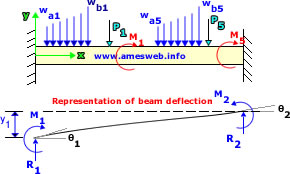
Fixed–Fixed Beam — Point Loads, Moments, UDL & Trapezoidal Load

Use this free beam calculator to analyze an encastre (fixed–fixed) beam carrying point loads, point moments (couples), uniform distributed loads (UDL), and linearly varying distributed loads (trapezoidal/triangular). Enter your spans and loads in any units and get support reactions, the shear force diagram (SFD), bending moment diagram (BMD), plus slope, deflection, and bending stress.

Jump to: Point load · Point moment · Uniform load (UDL) · Trapezoidal / triangular load (w₁→w₂) · Formulas · Related calculators

Global units
These selections apply to all inputs and results.
Input parameters
Unit:
Unit:
Unit:
Unit:
Fixed–fixed beam with a point load P at distance a from the left support over span L
Sign convention: P > 0 acts downward; position a is measured from the left fixed end; reactions are positive upward.
Point loads

Add one or more loads P at position a (from left).

P (lbf) a (ft) Action
Fixed–fixed beam with a concentrated moment M applied at distance a along span L
Sign convention: M > 0 is clockwise as drawn (top fibers in compression). Use negative for counter-clockwise.
Point moments (couples)

Add one or more applied moments M at position a (from left).

M (lbf·in) a (ft) Action
Fixed–fixed beam with uniform load w acting from position a to position b along span L
Sign convention: w > 0 is downward over the segment [a, b]. Both a and b are measured from the left fixed end and must satisfy a ≤ b.
Distributed loads (UDL)

Add one or more uniform loads w acting from position a to position b (end). Example: start a = 3 ft, length ℓ = 8 ft ⇒ b = 3 + 8 = 11 ft.

w (lbf/ft) a (ft) b (end) (ft) Action
Fixed–fixed beam with linearly varying (trapezoidal) distributed load w(x) acting downward between start a and end b over span L
Sign convention: w > 0 acts downward over [a, b].
Linearly varying loads (trapezoidal/triangular)

Add one or more loads where intensity varies linearly from w₁ at a to w₂ at b. Use w₂ = 0 (or w₁ = 0) for a triangular load. Sign convention: positive is downward.

w₁ at a (lbf/ft) w₂ at b (lbf/ft) a (ft) b (end) (ft) Action

Inputs (givens)

Applied loads

Sign convention used:
  • Axes: x-axis points to the right; y-axis points up.
  • Applied loads: P > 0 and distributed w > 0 act downward on the beam.
  • Support reactions: R₁ > 0 and R₂ > 0 act upward at the supports.
  • Applied moments: An externally applied couple M > 0 is clockwise as drawn.
  • Internal section: For a cut at position x: V(x) > 0 acts up on the left-hand cut face; M(x) > 0 is sagging (concave-up).
Results
Reaction Force R₁--- lbf
Reaction Force R₂--- lbf
Shear @ x (Vₓ)--- lbf
Max Shear (Vmax)--- lbf
Reaction Moment Left (M₁)--- lbf·in
Reaction Moment Right (M₂)--- lbf·in
Moment @ x (Mₓ)--- lbf·in
Max Moment (Mmax)--- lbf·in
Slope @ x (θₓ)--- radian
Max Slope (θmax)--- radian
End Slope Left (θ₁)0 radian
End Slope Right (θ₂)0 radian
Deflection @ x (yₓ)--- inch
Max Deflection (|y|max)--- inch
End Deflection Left (y₁)0 inch
End Deflection Right (y₂)0 inch
Bending Stress @ x (σₓ)--- psi
Max Bending Stress (σmax)--- psi

Formulas used (fixed–fixed beam)

Let L be the span, and a the distance from the left fixed end. UDL and trapezoid loads act on [a, b] with b ≥ a. The fixed end conditions θ₁ = θ₂ = 0 and y₁ = y₂ = 0 are enforced.

A) Single point load P at a

R₁ = (P/L³)·(L − a)²·(L + 2a)
R₂ = (P·a²/L³)·(3L − 2a)
M₁ = −(P·a/L²)·(L − a)²
M₂ = −(P·a²/L²)·(L − a)

For x ≤ a:
  V(x) = R₁
  M(x) = M₁ + R₁·x
For x ≥ a:
  V(x) = R₁ − P
  M(x) = M₁ + R₁·x − P·(x − a)
  

B) Single point moment (couple) M at a

R₁ = −(6M·a/L³)·(L − a)
R₂ = −R₁
M₁ = −(M/L²)·(L² − 4aL + 3a²)
M₂ =  (M/L²)·(3a² − 2aL)

For all x:     V(x) = R₁ (constant)
For x ≤ a:     M(x) = M₁ + R₁·x
For x ≥ a:     M(x) = M₁ + R₁·x + M

Bending stress:  σ = M·c / I
  

C) Uniform distributed load (UDL) w on [a, b]

Total load:   W = w·(b − a)

Support reactions (by fixed-end conditions):
  R₁ + R₂ = W
  M₁, R₁ obtained from EI-integration with θ₁ = θ₂ = 0, y₁ = y₂ = 0 (numeric for any [a, b]).

Shear (piecewise):
  0 ≤ x < a:   V = R₁
  a ≤ x ≤ b:   V = R₁ − w·(x − a)
  b < x ≤ L:   V = R₁ − w·(b − a)

Moment (piecewise):
  0 ≤ x < a:   M = M₁ + R₁·x
  a ≤ x ≤ b:   M = M₁ + R₁·x − ½·w·(x − a)²
  b < x ≤ L:   M = M₁ + R₁·x − ½·w·(b − a)² − w·(x − b)·(b − a)
  

D) Trapezoidal / linearly varying load w(x) on [a, b]

w(x) = w₁ + [(w₂ − w₁)/(b − a)]·(x − a),   for a ≤ x ≤ b; otherwise 0.
Total load:   W = (w₁ + w₂)/2 · (b − a)

Support reactions (by fixed-end conditions):
  R₁ + R₂ = W
  M₁, R₁ obtained by EI-integration (numeric) with θ₁ = θ₂ = 0, y₁ = y₂ = 0.

Shear:
  0 ≤ x < a:   V = R₁
  a ≤ x ≤ b:   V = R₁ − [ w₁·(x − a) + ½·k·(x − a)² ],  where k = (w₂ − w₁)/(b − a)
  b < x ≤ L:   V = R₁ − W

Moment:
  M(x) = M₁ + R₁·x − ∫ₐ^{min(x,b)} (x − s)·w(s) ds   (evaluated in closed-form in the code).
  

Related beam calculators

Support AMESWEB

If you find these engineering calculators helpful, you can support their maintenance and future development with a PayPal donation.

Donate via PayPal