Global units
These selections apply to all inputs and results. Choose force/length units first; other units adjust automatically.
Sign convention used on this page
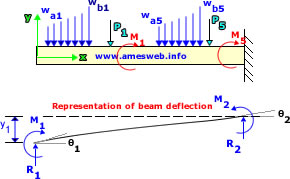
Coordinates are measured from the free end (x = 0) toward the fixed end (x = L).
+y is upward. Input loads: P > 0 downward, w > 0 downward.
+θ is clockwise rotation (free end rotates downward). Applied moment sign is as shown.
Quick check: P>0 (down) → y<0, θ>0, and M<0 near the fixed end.
Point Loads
Point loads (Pᵢ)
Concentrated Moments
Applied moments (M₀ⱼ)
Distributed Loads (linearly varying)
Distributed loads (wₖ : wₐₖ → w_bₖ on [aₖ, aₖ+bₖ])
Line load unit: lbf/ft
- Use dot “.” as decimal separator.
- Set all Pᵢ = 0 for a pure distributed / moment case; set all wₖ = 0 and M₀ⱼ = 0 for a pure point-load case, etc.
- Sign convention: P > 0 acts downward; w > 0 acts downward; shear/deflection positive upward; moments positive when compressing top fibers; slope positive up & to the right.
Need I? Try Sectional Properties Calculators.
Summary of applied loads
All loads below are shown using the selected global units.
| Type |
Value |
Position / Span |
Results — Combined Loading (Pᵢ + M₀ⱼ + wₖ)
| Parameter | Value |
| Reaction Force R₁ (free end) |
---
lbf |
| Reaction Force R₂ (fixed end) |
---
lbf |
| Shear @ x (Vₓ) |
---
lbf |
| Max Shear (Vmax) |
---
lbf |
| Reaction Moment Left (M₁ @ free end) |
---
lbf·in |
| Reaction Moment Right (M₂ @ fixed end) |
---
lbf·in |
| Moment @ x (Mₓ) |
---
lbf·in |
| Max Moment (Mmax) |
---
lbf·in |
| Slope @ x (θₓ) |
---
radian |
| Max Slope (θmax) |
---
radian |
| End Slope Left (θ₁ @ free end) |
---
radian |
| End Slope Right (θ₂ @ fixed end) |
---
radian |
| Deflection @ x (yₓ) |
---
inch |
| Max Deflection (ymax) |
---
inch |
| End Deflection Left (y₁ @ free end) |
---
inch |
| End Deflection Right (y₂ @ fixed end) |
---
inch |
| Bending Stress @ x (σₓ) |
---
psi |
| Max Bending Stress (σmax) |
---
psi |
Sign conventions
- x-axis: x is measured from the free end (x = 0) toward the fixed end (x = L).
- y-axis: +y is upward.
- Point load input P: P > 0 acts downward.
- Distributed load input w: w > 0 acts downward.
- Slope θ: +θ is clockwise rotation (free end rotating downward).
- Bending moment M: Moment sign is exactly as shown in the figure; the plots and stress use that same sign.
- Deflection y: y > 0 upward, y < 0 downward.
With these conventions, downward point loads (Pᵢ > 0) typically produce
negative shear and sagging (negative) bending moments near the fixed end,
rotations that are positive at the free end, and downward deflections.
Reference – superposition formulas
The calculator uses linear superposition of the contributions from each
individual load, together with numerical integration of the curvature
κ(x) = M(x) / (E I) to obtain slope and
deflection.
- Shear (global):
V(x) = − Σ Pᵢ for x ≥ aₚᵢ (each Pᵢ adds a downward step).
- Moment (global):
M(x) = − Σ [ Pᵢ · (x − aₚᵢ) ] (for x ≥ aₚᵢ)
+ Σ [ M₀ⱼ ] (for x ≥ aₘⱼ)
Each point load adds a linear segment; each applied
moment adds a constant jump in M(x) to the right of its position.
- Curvature:
κ(x) = M(x) / (E I)
- Slope and deflection:
θ(x) = θ(L) − ∫xL κ(ξ) dξ,
y(x) = y(L) − ∫xL θ(ξ) dξ
Fixed end conditions: θ(L) = 0, y(L) = 0.
These integrals are evaluated numerically along the span.
- Bending stress at distance c from neutral axis:
σ(x) = |M(x)| · c / I
The “max” values in the results table (Vmax, Mmax, θmax, ymax) correspond
to the extreme values by magnitude along the span. σₓ and σmax are shown
as |σ| using the selected stress unit.
What units can I use?
Any mix from the dropdowns—internally everything is converted consistently. Ensure E, I, lengths and loads align.
How are signs handled?
Point loads Pᵢ are positive when acting downward; applied moments M₀ⱼ are positive when they create sagging (top fibers in compression). Distances are measured from the free end.
Do you include shear deformation?
No—this is Euler–Bernoulli (plane sections remain plane). For deep beams, shear deflection may be non-negligible.
Can I model multiple loads?
Yes—up to 5 point loads, 5 applied moments, and 5 linearly varying distributed loads. The calculator uses linear superposition of their effects.
- Roark’s Formulas for Stress & Strain, Young & Budynas, McGraw-Hill.
- Machinery’s Handbook, Oberg et al., Industrial Press.
- Mechanics of Materials, Beer & Johnston, McGraw-Hill.
Support AMESWEB
If you find these engineering calculators helpful, you can support
their maintenance and future development with a PayPal donation.
Donate via PayPal